
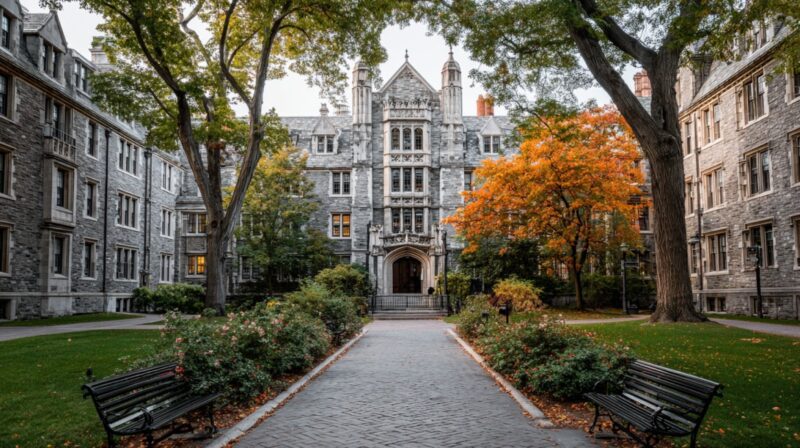
College admissions have grown increasingly competitive in recent years. Selective institutions now reject far more applicants than they accept. Acceptance rates provide one of the clearest indicators of how fierce the competition can be at top-tier colleges.
While global in scope, data is most consistent for institutions in the United States. U.S. colleges dominate the rankings due to transparency and consistent reporting practices.
Without further ado, let us begin.
| School Name | Acceptance Rate |
|---|---|
| Stanford University, Stanford, California | 3.95% |
| Curtis Institute of Music, Philadelphia, Pennsylvania | 4.2% |
| Yale University, New Haven, Connecticut | 4.46% |
| Harvard University, Cambridge, Massachusetts | 5.4% |
| Juilliard School, New York City, New York | 6.2% |
| Princeton University, Princeton, New Jersey | 6.5% |
| Columbia University, New York City, New York | 6.8% |
| Cornell University, Ithaca, New York | 6.9% |
| Alice Lloyd College, Pippa Passes, Kentucky | 7.1% |
| University of Chicago, Chicago, Illinois | 7.9% |
| Massachusetts Institute of Technology (MIT), Cambridge, Massachusetts | 7.9% |
| California Institute of Technology, Pasadena, California | 8.1% |
| United States Naval Academy, Annapolis, Maryland | 9% |
| Brown University, Providence, Rhode Island | 9.3% |
| Pomona College, Claremont, California | 9.4% |
| University of Pennsylvania, Philadelphia, Pennsylvania | 9.4% |
| Claremont McKenna College, Claremont, California | 9.4% |
| United States Military Academy, West Point, New York | 10% |
| Franklin W. Olin College of Engineering, Needham, Massachusetts | 10.2% |
| Dartmouth College, Hanover, New Hampshire | 10.6% |
| Northwestern University, Evanston, Illinois | 10.7% |
| Vanderbilt University, Nashville, Tennessee | 10.7% |
| Duke University, Durham, North Carolina | 10.8% |
| Johns Hopkins University, Baltimore, Maryland | 12.8% |
| Harvey Mudd College, Claremont, California | 12.9% |
| Pitzer College, Claremont, California | 13.7% |
| Amherst College, Amherst, Massachusetts | 13.7% |
| College of the Ozarks, Point Lookout, Missouri | 14.2% |
| Bowdoin College, Brunswick, Maine | 14.8% |
| Cooper Union, New York City, New York | 15.1% |
| Rice University, Houston, Texas | 15.1% |
| University of California-Berkeley, Berkeley, California | 16% |
| Mississippi Valley State University, Itta Bena, Mississippi | 16.2% |
| United States Air Force Academy, USAF, Colorado | 16.6% |
| Swarthmore College, Swarthmore, Pennsylvania | 17% |
| Washington University in St. Louis, St. Louis, Missouri | 17.1% |
| Middlebury College, Middlebury, Vermont | 17.3% |
| Tufts University, Medford, Massachusetts | 17.3% |
| Georgetown University, Washington, DC | 17.4% |
| Rust College, Holly Springs, Mississippi | 17.6% |
| Colorado College, Colorado Springs, Colorado | 18% |
| University of Southern California, Los Angeles, California | 18% |
| United States Coast Guard Academy, New London, Connecticut | 18.1% |
| University of California-Los Angeles (UCLA), Los Angeles, California | 18.5% |
| Williams College, Williamstown, Massachusetts | 19.4% |
| Washington and Lee University, Lexington, Virginia | 19.6% |
| Liberty University, Lynchburg, Virginia | 20.3% |
| Florida Memorial University, Miami, Florida | 20.5% |
| University of Notre Dame, Notre Dame, Indiana | 21.5% |
| Davidson College, Davidso, North Carolina | 21.7% |
| Missouri Valley College, Marshall, Missouri | 22.2% |
| United States Merchant Marine Academy, Kings Point, New York | 22.4% |
| Carleton College, Northfield, Minnesota | 22.8% |
| Vassar College, Poughkeepsie, New York | 23.5% |
| Barnard College, New York, New York | 23.7% |
| Wesleyan University, Middletown, Connecticut | 23.9% |
| Fort Valley State University, Fort Valley, Georgia | 24.2% |
| Art Academy of Cincinnati, Cincinnati, Ohio | 24.3% |
| Robert Morris University, Chicago, Illinois | 24.4% |
| Carnegie Mellon University, Pittsburgh, Pennsylvania | 24.6% |
| Haverford College, Haverford, Pennsylvania | 24.7% |
| Kenyon College, Gambier, Ohio | 25.1% |
| Bates College, Lewiston, Maine | 25.4% |
| Jackson State University, Jackson, Mississippi | 26.1% |
| Colgate University, Hamilton, New York | 26.1% |
| Warner University, Lake Wales, Florida | 26.2% |
| Babson College, Wellesley, Massachusetts | 26.4% |
| Hamilton College, Clinton, New York | 26.4% |
| Emory University, Atlanta, Georgia | 26.8% |
| Lincoln University, Lincoln University, Pennsylvania | 27.1% |
| Edward Waters College, Jacksonville, Florida | 27.3% |
| Scripps College, Claremont, California | 27.4% |
| California Institute of Arts, Valencia, California | 27.7% |
| CUNY–Baruch College, New York City, New York | 28% |
| Grinnell College, Grinnell, Iowa | 28% |
| Tulane University, New Orleans, Los Angeles | 28% |
| Colby College, Waterville, Maine | 28.1% |
| College of New Rochelle, New Rochelle, New York | 28.5% |
| University of North Carolina–Chapel Hill, Chapel Hill, North Carolina | 28.5% |
| CUNY–Lehman College, Bronx, New York | 29% |
| University of Virginia, Charlottesville, Virginia | 29% |
| Hampton University, Hampton, Virginia | 29.1% |
| Lafayette College, Easton, Pennsylvania | 29.8% |
| Chicago State University, Chicago, Illinois | 30% |
| Calumet College of St. Joseph, Whiting, Indiana | 30.3% |
| Wellesley College, Wellesley, Massachusetts | 30.5% |
| Bucknell University, Lewisburg, Pennsylvania | 30.7% |
| California Polytechnic State University–San Luis Obispo, San Luis Obispo, California | 30.9% |
| Hope International University, Fullerton, California | 31% |
| Wilson College, Chambersburg, Pennsylvania | 31.4% |
| Southwestern Adventist University, Keene, Texas | 31.5% |
| University of Richmond, University of Richmond, Virginia | 31.9% |
| Northeastern University, Boston, Massachusetts | 32% |
| University of Michigan–Ann Arbor, Ann Arbor, Michigan | 32.3% |
| Ohio Valley University, Vienna, West Virginia | 32.5% |
| Oberlin College, Oberlin, Ohio | 32.7% |
| College of William and Mary, Williamsburg, Virginia | 33% |
| Trinity College, Hartford, Connecticut | 33% |
| Webb Institute, Glen Cove, New York | 33% |
Stanford University, Stanford, California
View this post on Instagram
Stanford University holds a reputation as one of the most academically rigorous and innovation-driven institutions on the planet. With an acceptance rate below 4%, admission is reserved for students who not only excel in the classroom but also demonstrate creativity, resilience, and initiative.
Located in Silicon Valley, Stanford benefits immensely from proximity to tech giants, venture capital firms, and cutting-edge research labs. That strategic location amplifies its role as a launchpad for the next generation of thinkers and entrepreneurs.
Stanford’s environment values action as much as theory. Academic programs emphasize interdisciplinary collaboration, with students encouraged to cross boundaries between engineering, design, social sciences, and humanities.
Success in admissions requires more than numbers; applicants must bring a voice, vision, and record of meaningful engagement.
- Founding a nonprofit, leading major student initiatives, or driving meaningful change within their communities
- Original research, independent projects, or advanced academic pursuits outside traditional curriculum
- Evidence of risk-taking, problem-solving, or creating opportunities without institutional guidance
- Demonstrated record of making a difference in measurable, sustainable ways
Stanford also keeps its freshman class relatively small compared to the volume of applicants it receives, further amplifying its exclusivity. Each spot is reserved for someone who not only achieves but also elevates those around them.
Success at Stanford often begins with curiosity and grows through collaboration, driven by a campus culture that expects students to think forward, move fast, and reshape entire industries.
Curtis Institute of Music, Philadelphia, Pennsylvania
@curtisinstitute For 100 years, Curtis has been a place where dreams become legends. As we look toward the future, we continue to live by Mary Louise Curtis Bok’s example: breaking new ground in the education and training of great musicians. Discover the history of Curtis by visiting our website. #Curtis100 ♬ original sound – Curtisinstitute
Curtis Institute of Music operates as one of the most exclusive higher education institutions in the world. The school accepts around 5% of applicants annually, a figure that reflects its unwavering dedication to technical mastery and artistic excellence.
Each applicant is judged solely on performance, not grades or test scores, which sets Curtis apart even among elite music conservatories.
Admission is determined through highly competitive auditions. Candidates perform before accomplished faculty members, many of whom are internationally recognized performers and pedagogues. Even one missed note or weak phrase can close the door.
Class sizes are intentionally kept small to preserve the intense, individualized instruction that defines Curtis’s pedagogy. Most admitted students work directly under faculty mentors in what mirrors a professional training environment rather than a typical college program.
That structure creates an artist-to-artist relationship early in a student’s career.
- Fewer than 30 students admitted per year across all programs
- Faculty comprised of elite working musicians
- Admission based 100% on performance and live audition
- No application fee, encouraging global competition
- Full-tuition scholarships awarded to every admitted student
Financial support eliminates economic barriers, drawing applications from the most talented individuals worldwide. That open-door policy by cost only raises the bar in terms of raw talent, musical sophistication, and preparation.
Curtis graduates go on to perform with major orchestras, opera companies, and ensembles. Its alumni roster includes world-class soloists, concertmasters, composers, and conductors.
Yale University, New Haven, Connecticut
View this post on Instagram
Yale holds a prominent place among the most competitive institutions globally, with centuries of academic prestige and a firm commitment to liberal arts education. An acceptance rate of just over 4% means even top-performing applicants face long odds.
Gaining admission demands more than impressive transcripts; it requires a compelling balance of intellect, engagement, and authenticity.
Academic excellence is expected. Most successful applicants submit transcripts filled with honors, AP, IB, or A-level courses, along with top percentile standardized test scores. But numbers alone are never enough.
Yale’s admissions process seeks candidates who bring voice, perspective, and drive into every part of their application.
Yale’s emphasis on community-building and leadership is reflected in its residential college system and collaborative campus environment. Students are not just expected to perform well academically; they are encouraged to lead, create, and serve.
Successful candidates often bring a combination of academic curiosity, artistic or athletic accomplishment, and service-driven goals.
- Consistently high performance in advanced coursework, top SAT/ACT scores, and meaningful intellectual pursuits
- Long-term commitment and leadership in a few impactful activities, whether academic, artistic, athletic, or service-related
- Authentic, thoughtful essays that convey a sense of purpose, identity, and future goals
- Insightful letters highlighting initiative, empathy, collaboration, and resilience
- Interest in cross-cultural dialogue, language study, and participation in global or humanitarian programs
Yale’s approach values intellectual independence and social responsibility. Applicants are evaluated on potential as much as achievement, and decisions often reflect a holistic view of how each student might contribute to and grow within the university’s tight-knit and intellectually vibrant community.
Harvard University, Cambridge, Massachusetts
Without its international students, Harvard is not Harvard. https://t.co/V8uvTNaL64
— Harvard University (@Harvard) May 23, 2025
Harvard occupies a singular position in global academia. As the oldest institution of higher learning in the United States, it has an influence that extends into education, politics, law, science, and business.
Every year, tens of thousands of high-achieving students submit applications, knowing that fewer than 6% will be admitted.
The process is not just about grades and test scores; it also centers on leadership, service, intellectual depth, and personal character.
Admission officers search for candidates who possess more than academic success. They look for those who have already begun shaping their environments through initiative, innovation, and action.
- Perfect or near-perfect academic records in the most rigorous courses available
- Standardized test scores in the top 1% (though optional)
- Evidence of leadership in community, academic, or creative settings
- Original thought and purpose in essays and supplemental questions
- Strong recommendations from teachers and mentors who can attest to intellectual and personal excellence
With such a high number of qualified applicants, even students with impeccable records are frequently turned away.
Gaining admission requires a full-package profile and the ability to articulate why Harvard fits into long-term aspirations.
Juilliard School, New York City, New York
Juilliard has become synonymous with performance excellence in music, drama, and dance.
Located in Lincoln Center, it offers an immersive environment for artists who seek intensive, professional-level training. Unlike traditional universities, Juilliard does not focus on academic metrics.
Instead, students are evaluated almost entirely on their artistic performance and creative potential.
The acceptance rate hovers around 6%, driven by low enrollment capacity and staggering global competition. Faculty members include award-winning performers and directors, all of whom play a direct role in the admissions process.
- Technical mastery and interpretive skill
- Originality and emotional depth in performance
- Strong recommendations from artistic mentors
- Clear motivation for artistic development within Juilliard’s structured conservatory model
Program sizes remain intentionally small to preserve mentorship and access. Only those who demonstrate both raw talent and discipline earn a spot in this elite training ground.
Princeton University, Princeton, New Jersey
Princeton offers a combination of academic strength and personal mentorship rarely matched in higher education.
Students benefit from small class sizes, faculty accessibility, and one of the largest per-student endowments in the country. While the acceptance rate is just under 7%, numbers alone don’t capture how selective the school has become.
Admissions officers favor intellectual curiosity, a genuine love of learning, and contributions to academic communities. Princeton seeks students who ask hard questions and follow through with disciplined inquiry.
- High-level coursework with exceptional performance
- Demonstrated interest in academic exploration through research, projects, or independent study
- Thoughtful and original personal essays that reveal character and vision
- Teacher recommendations that highlight academic maturity and classroom engagement
- A record of leadership or service that shows responsibility and initiative
Once admitted, students receive unparalleled academic support and access to cutting-edge research opportunities even as undergraduates.
Columbia University, New York City, New York
View this post on Instagram
Columbia’s location in Manhattan plays a major role in shaping its educational style. Surrounded by media outlets, research centers, and major businesses, students engage with real-world ideas and urban life daily.
With nearly 60,000 applicants and an admit rate below 7%, Columbia’s admissions process remains highly competitive.
The university’s Core Curriculum fosters intellectual breadth and analytical skill, and it demands students who are both academically agile and culturally aware.
- Academic records filled with advanced coursework and high-level performance
- Strong interest in civic responsibility and public discourse
- Evidence of initiative in urban, global, or interdisciplinary environments
- Clear purpose in essays and a deep connection to Columbia’s programs and philosophy
- Recommendations that validate intellectual ambition and a collaborative mindset
Columbia’s distinct blend of tradition and modernity creates an educational experience rooted in ideas and action.
Cornell University, Ithaca, New York
View this post on Instagram
Cornell stands apart in the Ivy League due to its blend of public and private colleges under one institutional umbrella.
The structure allows for a wide range of programs, from hotel administration to engineering to agriculture, each with unique admissions criteria.
Overall, the university admits around 7% of applicants, though individual colleges may vary significantly in selectivity.
Cornell’s decentralized model places responsibility on applicants to know why they are applying to a specific college within the university. Vague or generic applications often fall flat.
- Targeted academic interests aligned with a specific school or program
- Deep engagement in relevant extracurricular or work experience
- Strong writing skills, particularly in school-specific supplemental essays
- A track record of discipline, intellectual risk-taking, or innovation
- High grades and scores in coursework relevant to intended majors
Cornell rewards clarity of purpose. Students who can articulate how their background matches a college’s mission stand the best chance of admission.
Alice Lloyd College, Pippa Passes, Kentucky
Alice Lloyd College operates on a model few others can claim, tuition-free education for students in a specific region, coupled with a mandatory work-study requirement.
Despite its rural setting and small size, the college’s mission-driven model creates a highly competitive admissions process with an acceptance rate just above 7%.
Applicants must meet geographic and academic qualifications and demonstrate financial need. They must also be prepared to contribute labor on campus through Alice Lloyd’s long-established work program.
- Strong community ties within the Central Appalachian region
- Consistent academic performance under economic or personal hardship
- Demonstrated leadership and a willingness to serve
- A track record of work ethic and responsibility
- Letters of recommendation that highlight personal integrity and potential
Admission to Alice Lloyd is as much about alignment with mission as it is about academic performance.
University of Chicago, Chicago, Illinois
University of Chicago attracts students who seek academic challenge, complex ideas, and intellectual independence.
It has built a reputation as a haven for thinkers who question, critique, and rewrite assumptions. Admission is highly selective, with just under 8% gaining entry.
Unlike colleges that reward polished resumes and prestige, Chicago places great value on how applicants think. Essays often feature unorthodox prompts that require creativity, originality, and clarity.
- Advanced coursework with top performance in humanities or sciences
- Thoughtful, even provocative responses to essay questions
- Demonstrated interest in intellectual risk-taking and academic debate
- Independent projects, competitions, or research
- A personal voice that reflects purpose, curiosity, and philosophical engagement
University of Chicago rewards students who are ready to immerse themselves in academic challenge, not for recognition, but for the love of inquiry itself.
Global Trends in College Selectivity
Top-tier institutions are facing overwhelming demand, resulting in record-low acceptance rates.
Ivy League schools dominate this pattern, frequently admitting fewer than 5% of applicants. Harvard, Stanford, Columbia, and Princeton often serve as benchmarks for this intense level of competition, not just for academics but for the limited number of available spots.
Historic reputation, immense financial resources, and wide influence attract some of the world’s highest-achieving students. As more qualified applicants apply each year, the admissions pool becomes more saturated, and selectivity intensifies.
Specialized Institutions Enter the Mix
Selective admissions are no longer exclusive to research universities. Highly focused colleges with narrow academic missions have also joined the ultra-exclusive ranks.
Music conservatories and military academies illustrate this shift clearly. Curtis Institute of Music and Juilliard admit only a handful of performers each year based on artistic excellence.
U.S. military academies such as West Point and the Naval Academy evaluate candidates based on academics, physical readiness, and leadership.
- Extremely small class sizes
- Single-track academic focus
- Mission-driven selection criteria
- National or international service commitments
Each of these factors eliminates casual applicants and raises the caliber of the pool.
Competitiveness Abroad
Countries like the United Kingdom, Japan, and South Korea also exhibit high levels of academic selectivity. Oxford and Cambridge maintain stringent academic requirements, personal statements, and intensive interviews.
Seoul National University and the University of Tokyo operate within cultures where educational status often determines future success.
Limited global data restricts broader comparisons. Many competitive institutions outside North America and Europe lack standardized public reporting, which skews rankings and analyses.
What Makes These Colleges So Selective?

Colleges with extremely low acceptance rates often display a combination of select characteristics that make them exceptionally difficult to access.
Academic Standards and Applicant Quality
Applicant pools at these colleges consist almost entirely of high achievers. Many candidates present perfect or near-perfect grades, standardized test scores, and extensive resumes.
Because of this overrepresentation of qualified individuals, selection often hinges on smaller, subjective details.
- Advanced coursework (AP, IB, A-levels)
- Standardized test excellence (SAT, ACT, TOEFL for international students)
- Top class rankings or national honors
When every applicant has impressive numbers, essays, interviews, and demonstrated character becomes a crucial differentiator.
Enrollment Caps and Institutional Constraints
Most ultra-selective colleges simply cannot expand enrollment without sacrificing their student-to-faculty ratios or academic quality. Harvard, for example, keeps its freshman class near 1,600 students according to its own data, despite tens of thousands of applications.
Smaller institutions such as Caltech or MIT are even more restricted in capacity due to laboratory demands and research intensity.
- Physical space limitations
- Faculty availability
- Curriculum structure
- Lab and studio resource constraints
Limited supply meets extreme demand, leading to brutal selection rates.
Specialization Drives Exclusivity
Institutions focused on arts, sciences, or military training inherently exclude most of the applicant pool due to their specific requirements.
Juilliard and Curtis accept only those with elite talent. U.S. military academies screen for fitness, leadership potential, and service commitment in addition to academics.
- Auditions or portfolio reviews
- Physical fitness assessments
- Congressional or military endorsements
- Psychological evaluations in some cases
Narrow fields, strict criteria, and service-based missions weed out the uncommitted.
Brand Value and Name Recognition
Reputation attracts massive attention.
High-school students worldwide often apply to prestigious names simply because of public image, increasing the number of unqualified applications and driving selectivity even higher.
- Global media attention
- Alumni networks and corporate pathways
- Rankings in publications
- Cultural capital in education-focused regions
Reputation, while often earned, becomes self-reinforcing through these cycles.
Admissions Strategy for Ultra-Selective Colleges
Gaining access to institutions with single-digit acceptance rates requires more than academic excellence. A strong application is intentional, personal, and tailored to each school’s specific expectations.
Academic Performance: The Baseline
Colleges expect academic excellence as a given, not an advantage. Most successful applicants already show near-perfect grades in the most rigorous classes offered at their schools.
- Maintain a high GPA, ideally with advanced-level coursework such as AP, IB, or A-levels
- Demonstrate consistent excellence across subjects, especially those related to intended majors
- Prioritize quality over quantity when enrolling in advanced classes
- Remain at or near the top of the class in rank or percentile
Standardized tests, even when optional, still carry weight in highly selective pools. High SAT or ACT scores validate academic achievement and help differentiate applicants in crowded fields.
Extracurricular Depth and Leadership
Activities outside the classroom must show sustained commitment and impact. Colleges value leadership, initiative, and passion over sheer volume.
- Focus on a few meaningful activities rather than listing many shallow ones
- Take leadership roles (e.g., club president, team captain, founder of an organization)
- Achieve regional or national recognition
- Contribute original work, research, or community improvement projects
Depth, not breadth, separates excellent candidates from merely qualified ones.
Essays and Personal Voice
Essays are among the most critical parts of the application. They reveal personality, priorities, and growth. Even with perfect grades and test scores, a weak essay can sink an application.
- Reflect personal experiences, not abstract ideas
- Highlight resilience, curiosity, or character
- Avoid clichés and over-polished writing
- Answer the prompt honestly and clearly
Supplemental essays, often asking “Why this college?”, require careful research and specificity. Generic responses signal a lack of effort or interest.
Methodology
The data used to determine college acceptance rates was compiled from publicly available sources, including official university admissions statistics, institutional research reports, and verified education databases.
When available, figures were taken directly from the most recent Common Data Set (CDS) submissions or official press releases by each college’s admissions office. In cases where schools did not publish formal acceptance data for the most recent cycle, the most reliable third-party reports with sourced figures were used.
Due to the lack of standardized international reporting across all countries, the focus remains primarily on institutions based in the United States. U.S. colleges offer the most transparent and consistently reported data, which includes total number of applicants, number of admitted students, and yield rates.
Acceptance rates were calculated using the basic formula: number of students admitted divided by number of applicants, multiplied by 100.
Specialized institutions such as music conservatories and military academies were included based on admissions figures published by those entities, often supplemented by admissions profiles or government disclosures. Data reflects the most recent admissions cycle available at the time of compilation.
Summary
Colleges with the lowest acceptance rates offer some of the most competitive academic environments worldwide. Ivy League giants, elite military academies, conservatories, and lesser-known liberal arts colleges all contribute to a shifting admissions climate defined by scarcity and selectivity.
Factors like academic rigor, institutional mission, and limited enrollment drive this exclusivity.
A narrow acceptance window does not automatically reflect the overall quality of education. Many exceptional schools offer valuable experiences without making headlines for record-low admit rates.
Applying only to ultra-selective colleges is a risky move. Broadening the application list increases the odds of finding both admission and academic satisfaction.
References:
- Inspiritai – What is Stanford Known For?
- Carnegieen Dowment – The Silicon Valley Model and Technological Trajectories in Context
- College Vine – Curtis Institute of Music
- Parchment – The Juilliard School
- Research Gate – Class size and academic results, with a focus on children from culturally, linguistically and economically disenfranchised communities
- US News – Ivy League Schools
- Alice Lloyd College – Student Work Program
- West Point – Candidate Fitness Assessment
- Harvard – So near, so far, at Harvard