
As of 2025, the University of California, Davis stands as one of the most diverse and academically balanced campuses in the UC system.
With over 39,000 students enrolled across undergraduate, graduate, and professional programs, UC Davis has evolved into a microcosm of California’s cultural, ethnic, and intellectual variety.
The 2025 incoming class reflects both growth and transformation, record-breaking applications, an increase in underrepresented students, and steady gender balance – cementing UC Davis’s role as a leading institution for inclusive higher education.
A Record Year for Enrollment and Diversity

UC Davis entered 2025 with unprecedented numbers:
These numbers highlight a university experiencing both growth and intentional diversification. UC Davis has been steadily expanding access to California residents while strengthening international recruitment.
Among the total applicant pool, 67 % of first-year applicants were California residents, underscoring the school’s continued mission to serve in-state students.
Gender Balance

While some universities lean heavily toward one gender, UC Davis maintains a consistent balance, though slightly favoring women. In the 2025 academic year, the student body was approximately 58.6 % women and 41.4 % men.
This distribution reflects larger national trends in higher education, where women now outnumber men in most undergraduate programs. At UC Davis, the ratio is especially visible in fields like biological sciences, veterinary medicine, and social sciences, where female enrollment outpaces male participation.
However, in engineering and computer science, the numbers are reversing gradually as the university introduces new initiatives for gender equity in STEM disciplines.
Racial and Ethnic Diversity: A California Mosaic
UC Davis’s student demographics mirror California’s population – multicultural, multilingual, and dynamic. The university is officially recognized as a Hispanic-Serving Institution (HSI), and more than 65 % of enrolled students identify as students of color.
The racial and ethnic composition for 2025 is as follows:
Ethnic Group
Approximate Share of Student Body
Asian
35.8 %
Hispanic / Latino
27.9 %
White (non-Hispanic)
24.2 %
Two or More Races
7.1 %
African American / Black
2.1 %
International Students
~16 % (overlapping category)
What This Means
UC Davis’s demographics illustrate a broad commitment to equity and representation. The university has made significant gains among Hispanic/Latino, Black, and Native student groups historically underrepresented in higher education.
Initiatives such as need-based scholarships, transfer pathways from California community colleges, and mentorship networks have contributed to this shift.
Asian students remain the largest single ethnic group on campus, with strong representation in STEM, business, and health sciences. Meanwhile, the steady growth of Latino enrollment highlights California’s demographic changes and the success of UC Davis’s outreach in urban and agricultural regions alike.
California Residents and Global Reach
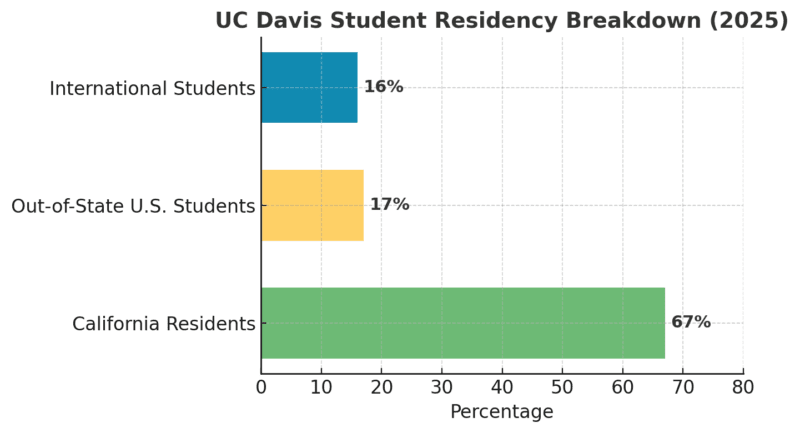
Despite being a global research institution, UC Davis remains rooted in serving Californians. Around two-thirds of all first-year students in 2025 were California residents, and nearly nine in ten transfer students came from California community colleges.
Still, the campus continues to attract a robust international population. Roughly 16 % of UC Davis students are from outside the United States, representing over 100 countries. The largest contingents come from China, India, South Korea, and Vietnam, with growing interest from Europe and the Middle East.
This global presence strengthens UC Davis’s position as an international hub for agricultural science, engineering, and environmental policy. The mix of local and international perspectives fosters a collaborative academic culture where California issues – such as climate resilience and sustainability – are discussed within a global framework.
Academic Diversity: From Agriculture to AI
UC Davis’s academic identity is anchored in its heritage as an agricultural and environmental research powerhouse, but the campus now spans every major field – from medicine and law to design and data science.
In 2025, the most popular undergraduate majors were:
STEM majors account for over 50 % of the undergraduate population, consistent with UC Davis’s national reputation in life sciences, veterinary medicine, and engineering.
The presence of interdisciplinary programs – like Sustainable Agriculture and Environmental Policy – has drawn students interested in climate innovation and food systems.
Graduate demographics show similar diversity, with notable increases in data analytics, energy systems, and biotechnology programs, reflecting market demand and California’s economic priorities.
Socioeconomic and First-Generation Representation
UC Davis continues to expand access for first-generation and low-income students. Nearly one-third of UC Davis undergraduates are first-generation college students, and over 35 % receive Pell Grants.
These statistics reinforce the university’s ongoing commitment to educational equity. UC Davis’s Aggie Compass Basic Needs Center, affordable housing initiatives, and partnerships with local food producers all contribute to student retention and well-being, especially among those balancing academic and financial pressures.
Socioeconomic Indicator
Estimated Share (2025)
First-Generation Students
~33 %
Pell Grant Recipients
~35 %
Low-Income Households (CA definition)
~29 %
UC Davis as a Reflection of California
View this post on Instagram
UC Davis is not just a university; it’s a demographic snapshot of California’s future. The diversity of its student body reveals a generation that is multilingual, socially conscious, and globally connected.
The campus’s population includes children of immigrants, first-generation scholars, and international students who collectively bring new perspectives to education, research, and community life.
The university’s record number of applications and expanding diversity metrics also signal a growing public trust in UC Davis as a place where inclusion is not just a value, but a measurable outcome.
With over 65 % students of color, rising international enrollment, and nearly balanced gender representation, UC Davis embodies what a modern, forward-looking research institution in the United States should represent in 2025: accessible excellence.
Key Takeaways
Category
Highlights (2025)
Total Applications
120,131 (record high)
New Undergraduate Enrollees
9,443
Students of Color
65 % +
Gender Balance
59 % women / 41 % men
California Residents
67 % of first-year students
International Students
~16 %
First-Generation
~33 %
Pell Grant Recipients
~35 %
Conclusion
@ucdavis A perfect day at UC Davis, as told by Aggies ?✨ #UCDavis ♬ original sound – UC Davis
The 2025 UC Davis student profile reflects a university that is growing not just in numbers, but in purpose. It’s a campus where global meets local, where first-generation scholars study beside international peers, and where diversity drives innovation.
From record admissions to broader socioeconomic inclusion, UC Davis stands as proof that when a public university commits to accessibility, representation, and academic rigor, it can redefine what higher education looks like for an entire generation.